

 Deutsch
 Nederlands
 Dansk
Dansk Italiano
 Français
 Español
 Suomi
Suomi Svenska
 Polski
5 Min. read · Updated: March 2026
Table of Contents
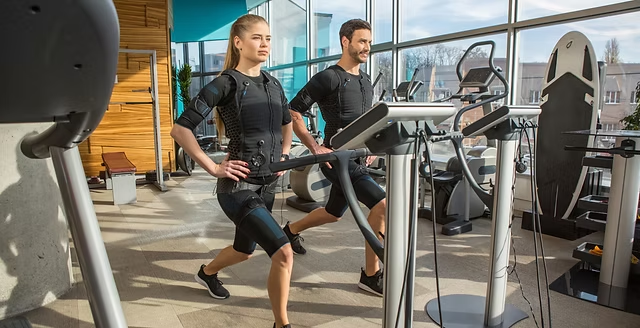
EMS training is considered a highly efficient method for building muscle in record time, but how does the electrical impulse compare to classic weight training? While it often takes years in the gym to specifically target deeper muscle layers, EMS directly stimulates the motor nerves, ensuring almost complete activation of the fibers.
The special thing about it: The simultaneous stimulation of agonists and antagonists creates tension curves that are barely achievable with conventional exercises. This not only leads to faster strength gains but also sets new hypertrophy stimuli even for experienced athletes, sustainably promoting muscle growth and stabilizing body posture.
Stimulus Intensity: Why EMS goes deeper
In conventional strength training, your brain decides which muscle fibers are activated. EMS bypasses this “biological barrier” and applies the stimulus directly to the muscle.
The Result: You train muscles you didn’t even know you had. The back and core muscles in particular benefit from this total activation.
Muscle Growth: How hypertrophy occurs
Muscles don’t grow during training, but in the recovery phase afterwards. EMS sets a particularly strong growth stimulus through extreme contractions.
The 3-Stage Effect
1
Mechanical Tension: The electrical impulses force the muscle into a contraction that is stronger than what your brain could produce alone. This creates microtraumas in the muscle fibers.
2
Metabolic Stress: Due to the high frequency of the impulses, blood flow is briefly interrupted and lactate accumulates – a chemical signal for the body to build muscle.
3
Supercompensation: In the resting phase, the body repairs the fibers, making them thicker and stronger than before to be prepared for the next load.
Did you know? EMS specifically targets the “fast” Type II muscle fibers. These have the greatest potential for visible thickness growth (hypertrophy).

In Comparison
The Most Versatile EMS Suits
Technical masterpieces, price-performance winners and great innovation and effectiveness.
To the full comparison →Training & Regeneration: The timing for success
Those who train every day don’t build muscle – they destroy it. With high-intensity EMS training, recovery is just as important as the electrical stimulus itself.
⏱️
20 minutes are enough
Due to the enormous training density, 20 minutes of EMS is physiologically comparable to about 90-120 minutes of conventional strength training. More time leads to exhaustion, not more growth.
🔋
Recovery Window
After a full-body EMS workout, your body needs at least a 72-hour break. During this time, it repairs the fibers and stores new proteins (supercompensation).
Important for growth: Ensure a protein-rich diet and sufficient sleep during the recovery phase. Without building blocks (amino acids), the muscle cannot convert the stimulus into mass.
Strength Gains: Power through neural adaptation
True strength comes not only from muscle volume, but from the ability of your nervous system to “fire” as many fibers as possible simultaneously. EMS is the perfect training for this neural efficiency.
Studies show that athletes can increase their maximum strength by up to 30% in a few weeks through EMS, as intramuscular coordination is improved.